ScAILab · Research
Selected Research Projects
Representative work from the Scientific Artificial Intelligence Lab, spanning physics-guided deep learning, anomaly detection, and disease forecasting under data paucity. Hover a card to magnify it; click to open the paper or code.
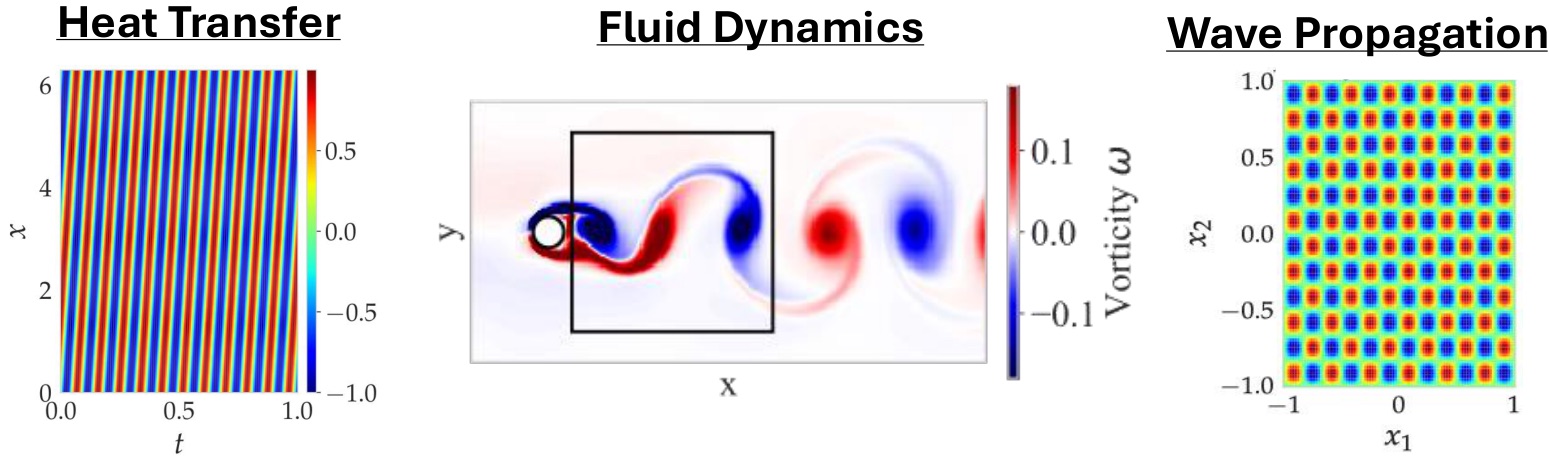
LIGO-PINN: Learned Initialization via Gated Optimization to Alleviate Convergence Failures in Physics Informed Neural Networks
Physics-informed neural networks often converge poorly, sometimes to trivial solutions, on challenging PDE domains. LIGO-PINN traces these catastrophic failures to network initialization, a surprisingly under-investigated factor, and learns the initial weights through gated layerwise optimization. Across 1D and 2D domains including a challenging 2D fluid dynamics setting, it improves on six state-of-the-art baselines by 91.5% on average and generalizes to 3D unstructured domains.
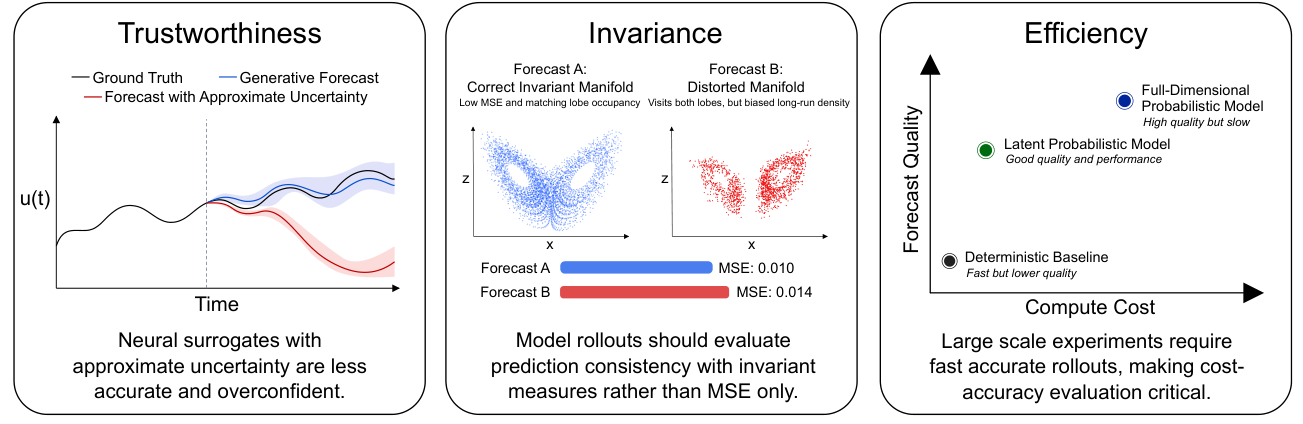
TRIE: An Evaluation Framework for Stochastic PDE Surrogates
An evaluation framework for stochastic PDE surrogates that asks whether models reproduce invariant measures, provide trustworthy predictive uncertainty, and scale to efficient probabilistic generation. Across stochastic Kuramoto–Sivashinsky and Kolmogorov flow at 11 parameter values, pointwise-trained surrogates give plausible short rollouts but miss long-time statistics, while generative models achieve the lowest CRPS. Latent generative models cut Kolmogorov inference time by roughly 12×.
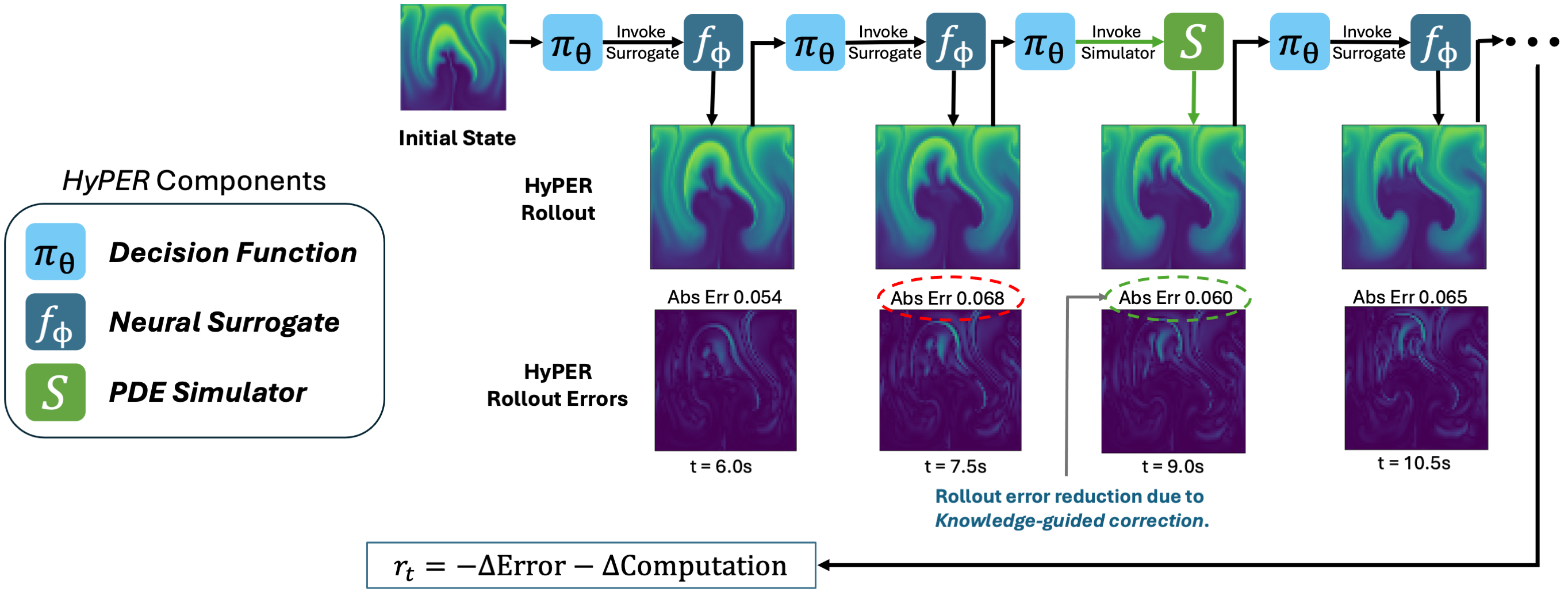
Model-Agnostic Knowledge Guided Correction for Improved Neural Surrogate Rollout
Neural surrogates are far cheaper than PDE simulators but accumulate large rollout error when run autoregressively, especially under data paucity. HyPER is a model-agnostic, cost-aware reinforcement learning model that decides when to invoke a physics simulator, with or without gradients, to correct a neural surrogate. It reduces in-distribution rollout error by 47–78% and learns a policy that adapts to changing physical conditions and resists noise corruption.
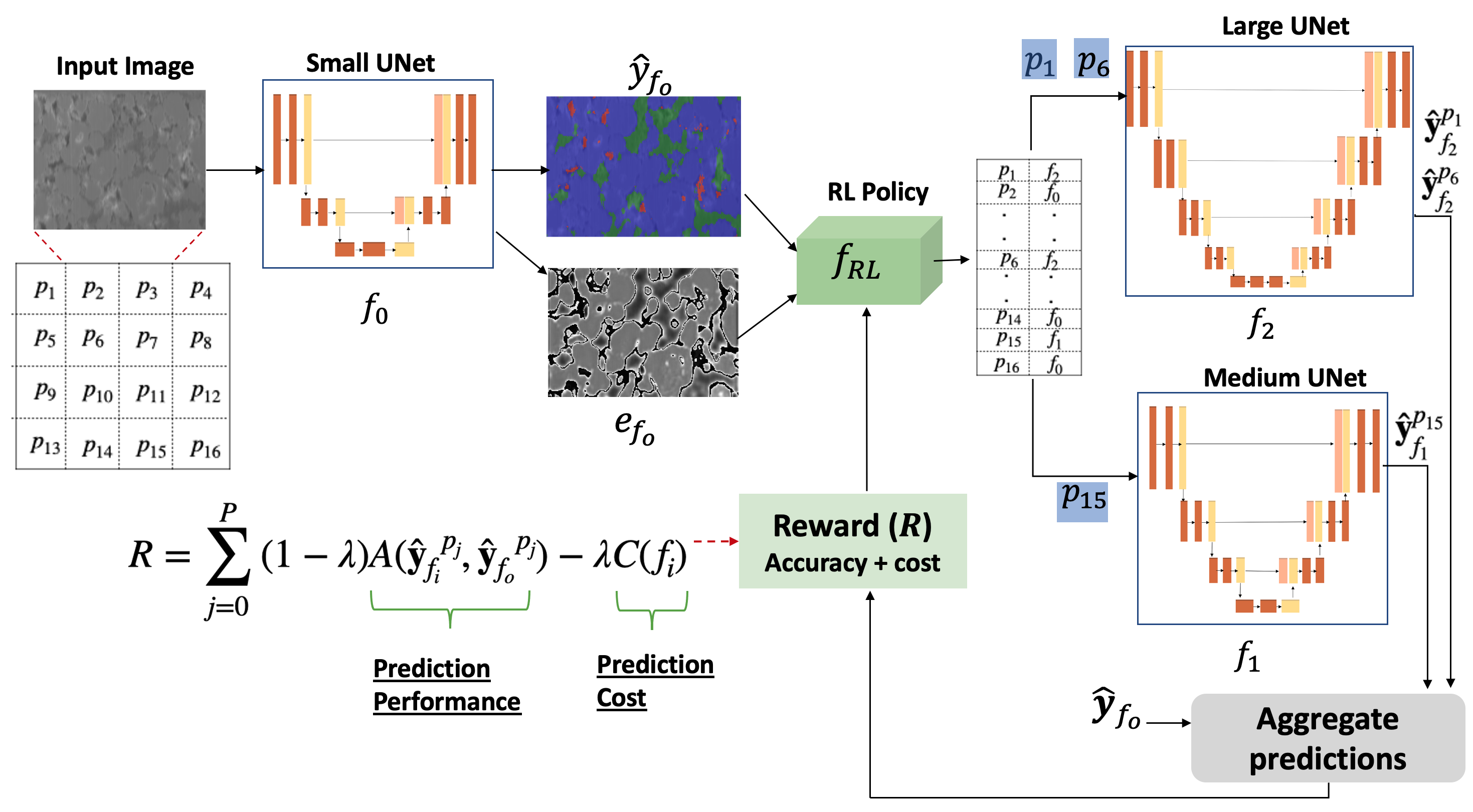
Reinforcement Learning as a Parsimonious Alternative to Prediction Cascades: A Case Study on Image Segmentation
Over-parameterized vision architectures are infeasible in low-resource IoT settings, and decision cascades waste computation on intermediate models. PaSeR is a non-cascading, cost-aware learning pipeline that reaches better accuracy at lower cost. Evaluated with a new IoU/GigaFlop metric, it improves by at least 174% on battery material phase segmentation and 13.4% over state-of-the-art models on noisy MNIST.
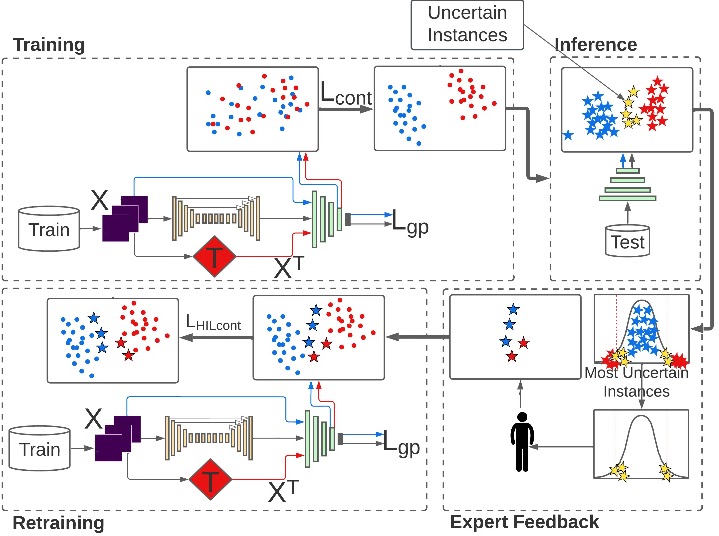
Detecting Irregular Network Activity with Adversarial Learning and Expert Feedback
A self-supervised deep learning framework, CAAD, for anomaly detection in wireless communication systems. It uses contrastive learning in an adversarial setup to learn representations of normal and anomalous behavior, yielding a 92.84% mean performance improvement over state-of-the-art techniques. An augmented variant (CAAD-EF) incorporates expert feedback through a contrastive feedback loop to reduce prediction uncertainty.

PhyFlow: Physics-Guided Deep Learning for Generating Interpretable 3D Flow Fields
A physics-guided deep learning architecture for modeling 3D multi-phase fluid flows, designed to mimic the projection method used in CFD simulations. PhyFlow generates high-quality flow fields with a 49.61% improvement over state-of-the-art baselines, improves downstream particle drag force prediction by 9.89%, and remains consistent with known governing equations.
Read paper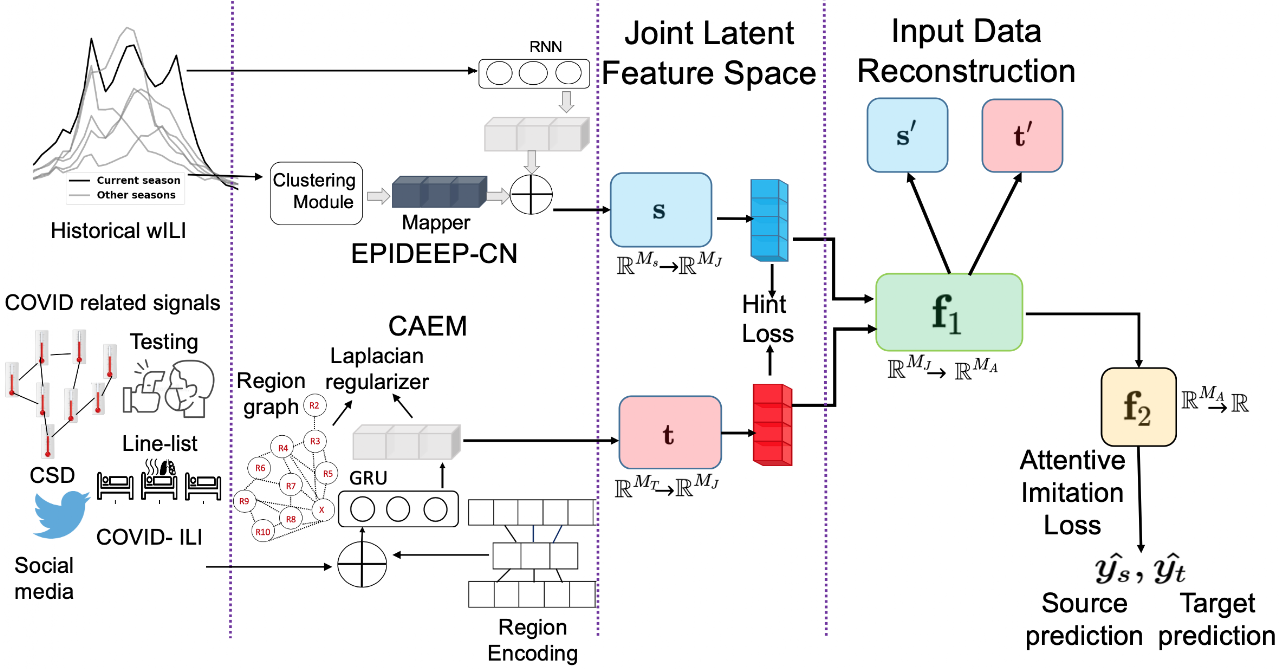
Steering a Historical Disease Forecasting Model Under a Pandemic
CALI-Net is a neural transfer learning architecture that uses knowledge distillation to "steer" a historical disease forecasting model into scenarios where flu and COVID-19 co-exist. It learns to emphasize either COVID-related signals or historical forecasting models at appropriate times, exploiting historical ILI representations alongside limited COVID-related signals.
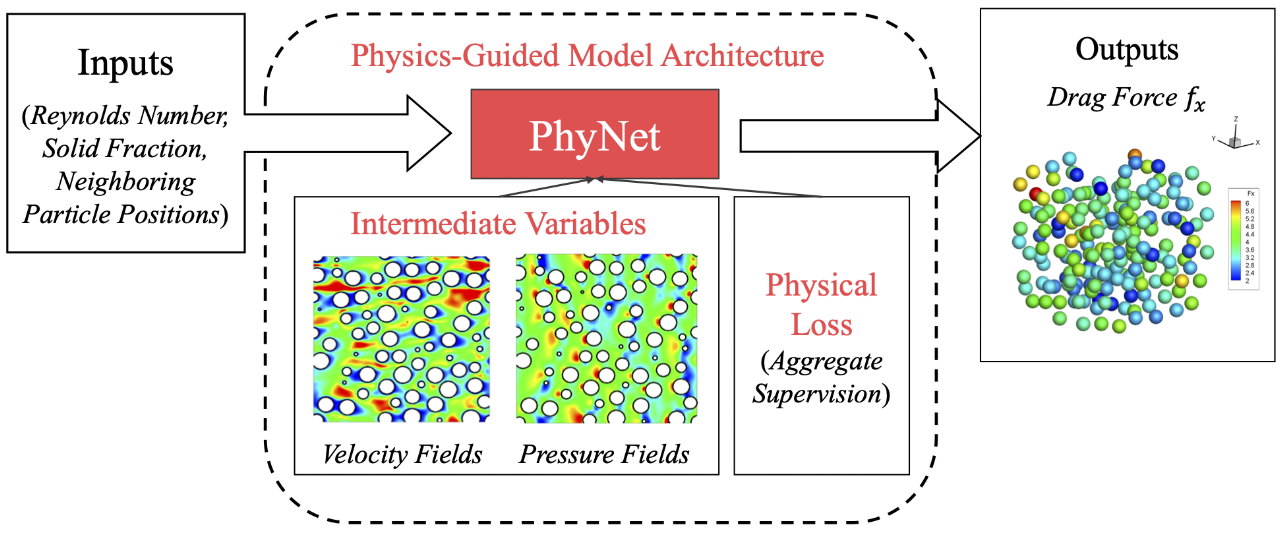
PhyNet: Physics Guided Neural Networks for Particle Drag Force Prediction
A deep learning model using physics-guided structural priors and physics-guided aggregate supervision to model the drag forces acting on each particle in a Computational Fluid Dynamics-Discrete Element Method (CFD-DEM) setup. Extensive experiments showcase the value of incorporating physics knowledge directly into the learning formulation under data paucity.
Read paper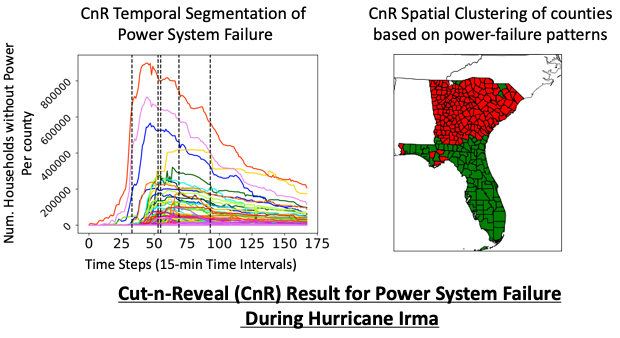
Cut-n-Reveal: Temporal Segmentation with Explanations
CnR is a scalable segmentation-with-explanations framework that segments power-outage sequences based on temporal variations in the failure process, accounting for spatial and temporal correlations. A novel explanation optimization highlights the culprit time-series behind each segment. On real county-level outage data from hurricanes Matthew, Harvey, and Irma, CnR recovers actionable patterns baselines miss.
Read paper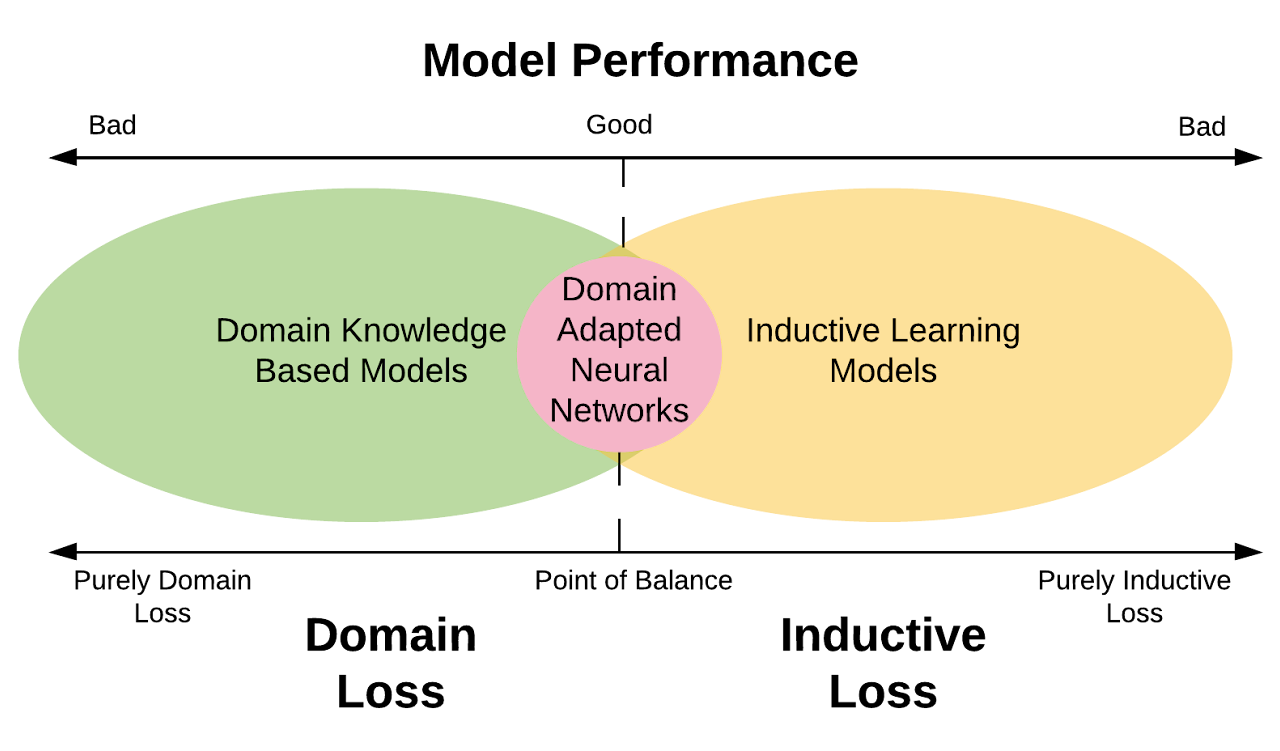
Incorporating Prior Domain Knowledge into Deep Neural Networks
Domain Adapted Neural Networks (DANN) integrate domain knowledge into model training via loss terms for monotonicity and approximation constraints. Evaluated on synthetic Bohachevsky data and a real-world oxygen-solubility dataset, DANN outperforms its domain-agnostic counterpart with an overall mean performance improvement of 19.5% (4% worst-case, 42.7% best-case).
Read paper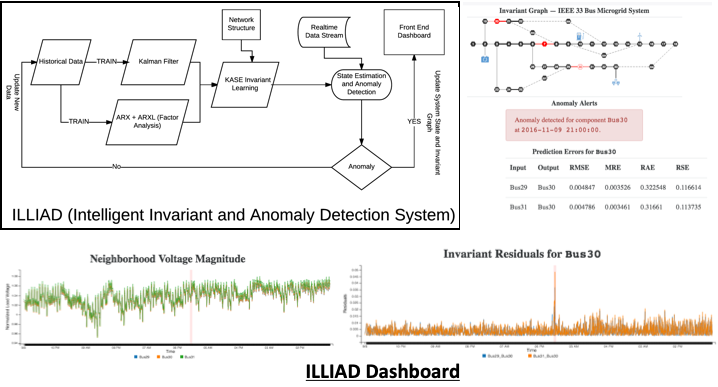
illiad: Intelligent Invariant and Anomaly Detection in Cyber-Physical Systems
An online monitoring system that models the state of a cyber-physical system as a function of relationships between its constituent components, combining model-based and data-driven strategies. illiad exploits the underlying network structure (wired or wireless) for state estimation, demonstrated on a wireless sensor motes application and an IEEE 33-bus microgrid.
Read paper