Our group at the Scientific Artificial Intelligence (ScAI) Lab develops machine learning and AI methods that accelerate scientific discovery in domains governed by physical laws, from fluid dynamics and chemistry to the earth sciences. Much of our work centers on Parsimonious SciML: designing neural surrogates that faithfully model complex physical systems even under severe data paucity, where simulations are too costly to produce the data that conventional models demand. We are especially motivated by the opportunities modern AI and machine learning offers in accelerating large-scale computational simulations and strive to develop generalizable AI/ML models by embedding scientific domain knowledge directly into models so that predictions remain accurate, physically consistent, and able to generalize beyond the training regime. Our research is supported by organizations like eBay Inc. and Stevens Institute of Technology.
Research Focus
The work at the ScAI Lab can be generally organized into three interconnected research themes. Select a theme below to explore its core challenges and the peer-reviewed publications that address them.
AI for Scientific Discovery ▼ We build physics-guided neural surrogates that faithfully model complex physical systems under severe data paucity, organized around four core research challenges. Expand for challenges & publications ▼Collapse ▲
We design neural surrogates that faithfully model complex physical systems under severe data paucity. This program is organized around four open challenges that stand between today's data-driven surrogates and trustworthy scientific deployment.
Core Research ChallengesAutoregressive neural surrogates accumulate error as they roll forward in time, while their spectral bias toward low frequencies leaves the fine-scale, high-frequency structure of physical fields under-resolved — eroding long-horizon fidelity.
The space of physical configurations, geometries, and parameters is enormous, while the high-fidelity simulations that generate training data are prohibitively costly — forcing surrogates to learn a high-dimensional map from only sparse samples.
Physics-informed and constrained neural surrogates are notoriously hard to optimize: stiff loss landscapes, initialization sensitivity, and competing objectives cause training to stall or converge to non-physical solutions.
Surrogates that interpolate well within their training regime break down when asked to generalize to unseen parameters, geometries, or dynamical regimes — precisely the setting scientific deployment most demands.
- TRIE: An Evaluation Framework for Stochastic PDE Surrogates — arXiv preprint
- LIGO-PINN: Learned Initialization via Gated Optimization to Alleviate Convergence Failures in Physics-Informed Neural Networks — arXiv preprint
- Finetune-Informed Pretraining Boosts Downstream Performance — arXiv preprint
- Learning and Interpreting Drag Force Models for Dense Particle Suspensions Using Graph Neural Networks — Powder Technology 2025
- Science-Guided Transfer Learning for Molecular Dynamics of Confined Fluids in Shale Nanopores — Fluid Phase Equilibria 2025
- Model-Agnostic Knowledge Guided Correction for Improved Neural Surrogate Rollout — ICLR 2025
- Counter Data Paucity through Adversarial Invariance Encoding: A Case Study on Battery Thermal Runaway — IEEE Big Data 2024
- Reinforcement Learning as a Parsimonious Alternative to Prediction Cascades — AAAI 2024
- Physics Informed Deep Learning for Flow and Force Predictions in Dense Ellipsoidal Particle Suspensions — Powder Technology 2024
- Comparison of Reduced Order Models Based on Dynamic Mode Decomposition — Physics of Fluids 2023
- Deep Learning Methods for Predicting Fluid Forces in Dense Particle Suspensions — Powder Technology 2022
- PhyFlow: Physics-Guided Deep Learning for Generating Interpretable 3D Flow Fields — IEEE ICDM 2021
- Physics-Guided Deep Learning for Drag Force Prediction in Dense Fluid-Particulate Systems — Big Data 2020
- PhyNet: Physics Guided Neural Networks for Particle Drag Force Prediction in Assembly — SIAM SDM 2020
AI for Cyber-Physical Systems ▼ We learn system invariants and detect anomalies, adversarial attacks, and faults in the noisy, real-time sensor and wireless data streams that cyber-physical systems produce. Expand for challenges & publications ▼Collapse ▲
- ILLIAD: Intelligent Invariant and Anomaly Detection in Cyber-Physical Systems — ACM TIST 2018
- Incorporating Prior Domain Knowledge into Deep Neural Networks — IEEE Big Data 2018
- Detection of False Data Injection Attacks in Cyber-Physical Systems Using Dynamic Invariants — IEEE ICMLA 2019
- Contrastive Graph Convolutional Networks for Hardware Trojan Detection — IEEE HOST 2021
- Efficient Generative Wireless Anomaly Detection for Next Generation Networks — IEEE MILCOM 2022
- Detecting Irregular Network Activity with Adversarial Learning and Expert Feedback — IEEE ICDM 2022
- Large Multi-Modal Models (LMMs) as Universal Foundation Models for AI-Native Wireless Systems — IEEE Network 2024
- NMformer: A Transformer for Noisy Modulation Classification in Wireless Communication — IEEE WOCC 2024
- DenoMAE: A Multimodal Autoencoder for Denoising Modulation Signals — IEEE Communications Letters 2025
- DenoMAE2.0: Improving Denoising Masked Autoencoders by Classifying Local Patches — IEEE Transactions on Communications 2025
Spatiotemporal and Disease Modeling ▼ We design attention-based and sequence-to-sequence models for long-horizon forecasting, disease modeling, and interpretable analysis of complex, high-dimensional dynamical systems. Expand for challenges & publications ▼Collapse ▲
- DyAt Nets: Dynamic Attention Networks for State Forecasting in Cyber-Physical Systems — IJCAI 2019
- Multivariate Long-Term State Forecasting in Cyber-Physical Systems: A Sequence to Sequence Approach — IEEE Big Data 2019
- Cut-n-Reveal: Time Series Segmentations with Explanations — ACM TIST 2020
- Steering a Historical Disease Forecasting Model Under a Pandemic — AAAI 2021
- Evaluation of FluSight Influenza Forecasting in the 2021–22 and 2022–23 Seasons — Nature Communications 2024
Members
I am proud of each of my mentees and am thankful for the opportunity to mentor them as well as for all that I have learned from them during the mentoring experience.
If you are interested in joining the ScAI Lab, please see Open Positions.
Ph.D Students
Research
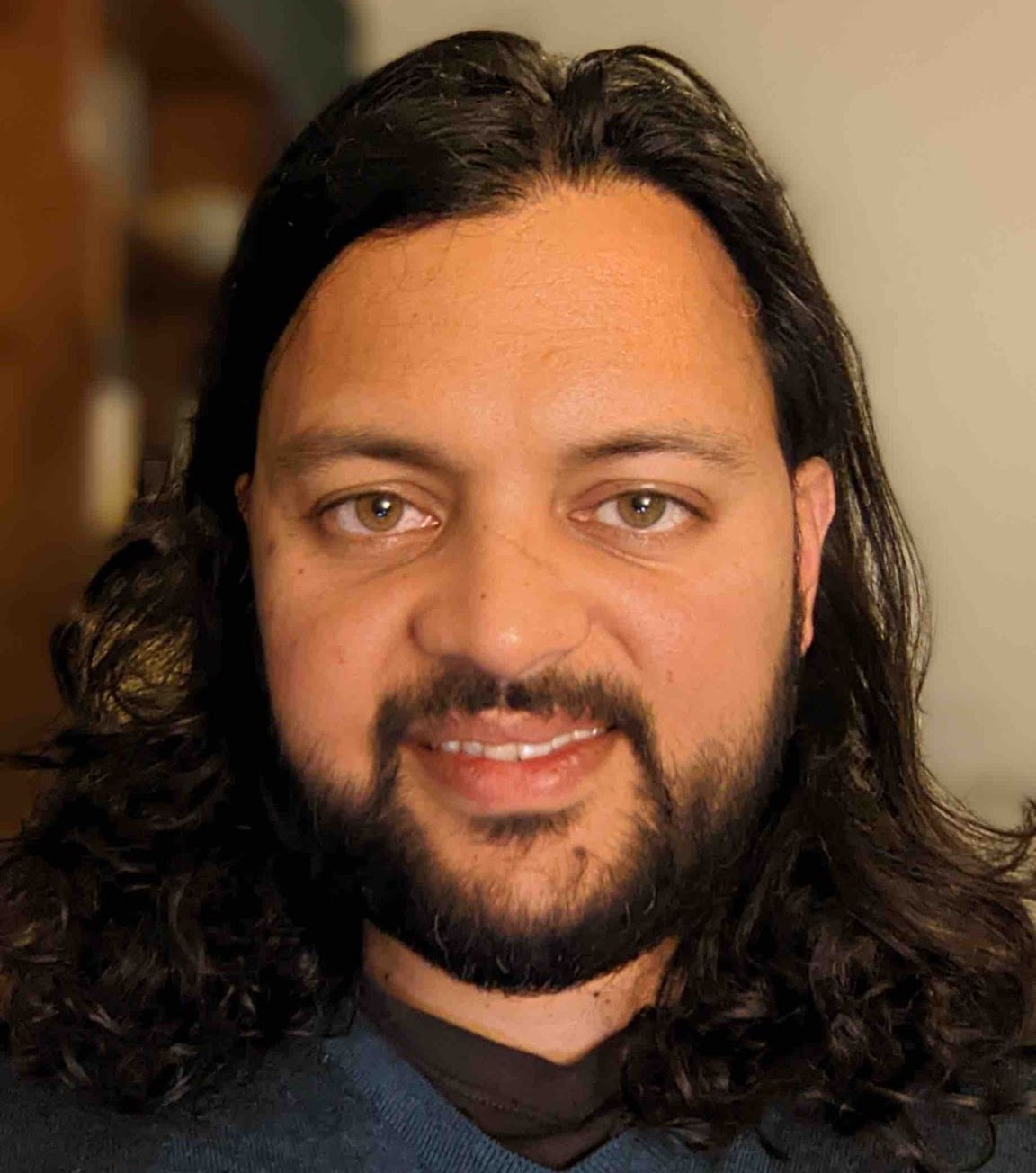
Bharat's research is focused on developing machine learning techniques with a focus on improved generalization under data paucity and compute paucity contexts. Bharat's research has been published in prestigious venues like AAAI and ICLR.
M.S. Students
Research
Research summary coming soon.
Research
Research summary coming soon.
Research
Research summary coming soon.
High School Students

Research
Research summary coming soon.

Research
Research summary coming soon.
Research
Research summary coming soon.